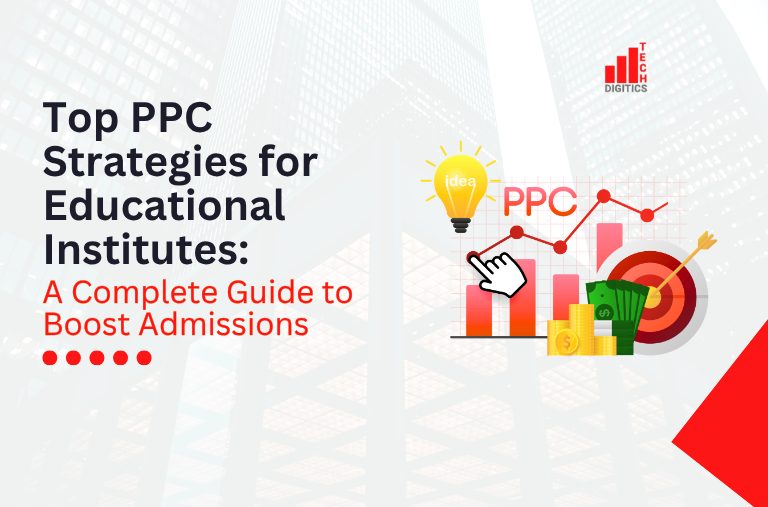
Notice boards are gathering dust; search engines are gathering students. If your institute isn’t appearing first with a clear message, you’re losing seats to those who are. Precision targeting isn’t just an option, it’s your digital front door. PPC advertising strategies is how that happens.
But there’s a catch: a poorly planned campaign burns money fast with little return. The institutes winning through paid ads aren’t just spending, they’re strategising. Here’s exactly how they do it.
1. Understand Your Audience Deeply
One message doesn’t fit all, not in education. Parents and students are walking into the same decision from completely different directions. Speak to a parent the way you’d speak to a student, and you’ve already lost them. Get the segmentation right, speak to what each group actually cares about, and suddenly your messaging doesn’t just reach people, it resonates.
- Students (school, undergraduate, postgraduate)
- Parents (especially for K-12 education)
- Working professionals (for certifications or online courses)
Each group has different motivations, concerns, and search behaviors.
How to apply this:
- Create detailed audience personas
- Identify pain points (e.g., affordability, career prospects, location)
- Tailor messaging accordingly
For example, a parent may respond better to messaging about safety and academic excellence, while a student might focus on career outcomes and campus life.
2. Use High-Intent Keywords for PPC Strategies
Not all keywords are created equal. In PPC, targeting high-intent keywords ensures that your ads reach users who are actively looking to enroll.
Examples of high-intent keywords:
- “best MBA college near me”
- “online data science course with certification”
- “admission open 2026 engineering college”
Strategies:
- Go long-tail specific keywords may have lower search volume, but they bring in students who are far more likely to convert
- Think local if you have a physical campus; location-based keywords help you show up for students searching nearby
- Keep your keyword list alive, trends shift, and your strategy should shift with them
- Avoid casting too wide a net. Broad terms like “college” or “courses” can waste budget fast without the right filters in place
Avoid overly broad terms like “college” or “courses” unless paired with strong filters.
3. Optimize Ad Copy for Conversions
Your ad copy is the first interaction users have with your institute. It must be compelling, clear, and action-oriented.
Key elements of high-performing ad copy:
- Strong headline (highlight USP)
- Clear value proposition
- Emotional triggers (career success, placements, rankings)
- Highlight top recruiters and average placement packages to attract decision-ready students.
- Mention campuses, cities, or regions if applicable. Helps with local targeting and relevancy.
- Tap into aspirations and concerns: career growth, success stories, alumni achievements.
- Career-ready skill sets and Specialized certifications
- Showcase your unique advantage: placements, global exposure, NAAC/NIRF ranking, and modern infrastructure.
- Clear Call-to-Action (CTA)
Encourage immediate action with multiple channels:
Examples of CTAs:
- “Apply Now”
- “Book Free Counseling”
- “Download Prospectus”
- Website / Form: “Apply Now” / “Download Prospectus”
- Counseling: “Book Free Counseling”
- Direct Contact: “Chat Now” / “Call Us Today” / “Message on WhatsApp”
Pro tip: Use numbers and credibility markers like “Top Ranked,” “100% Placement Assistance,” or “20+ Years of Excellence.”
4. Leverage Geo-Targeting
Most educational institutes serve specific geographic regions. Geo-targeting helps ensure your ads are shown only to relevant audiences.
Benefits:
- Reduces wasted ad spend
- Improves lead quality
- Increases conversion rates
How to use it effectively:
- Target cities or regions where your institute operates
- Exclude irrelevant locations
- Adjust bids based on location performance
For example, a college in Delhi should prioritize nearby cities like Gurgaon, Noida, and Ghaziabad.
5. Create Dedicated Landing Pages
Here’s a mistake: too many institutes spend on ads and then send everyone to the same busy homepage. It’s like inviting someone to a meeting and then asking them to find the room themselves. A dedicated landing page changes that. It speaks directly to what the student was searching for and guides them towards taking action.
A landing page that actually converts should include:
A good landing page should include:
- Clear headline aligned with the ad
- Program details and benefits
- Testimonials and success stories
- Easy-to-fill inquiry form
- Include details for the student’s nearest or preferred campus.
- Strong CTA
- Specialized landing pages for each course
- Create separate landing pages for each program or specialization (MBA, B.Tech, BCA, MBA – Finance, MBA – Marketing, etc.)
- Showcase program-specific outcomes like career growth, skill development, and employability.
- Include alumni stories, placement highlights, or top recruiters.
- Key curriculum highlights, certifications, internship opportunities, and global exposure.
Why it matters:
A well-optimized landing page ensures consistency and builds trust, significantly improving conversion rates.
6. Use Remarketing to Re-Engage Visitors
Not every visitor converts on the first visit. Remarketing allows you to reconnect with users who previously interacted with your website or ads.
Remarketing ideas:
- Show ads to users who visited course pages
- Offer reminders for “admission closing soon.”
- Provide incentives like scholarships or discounts
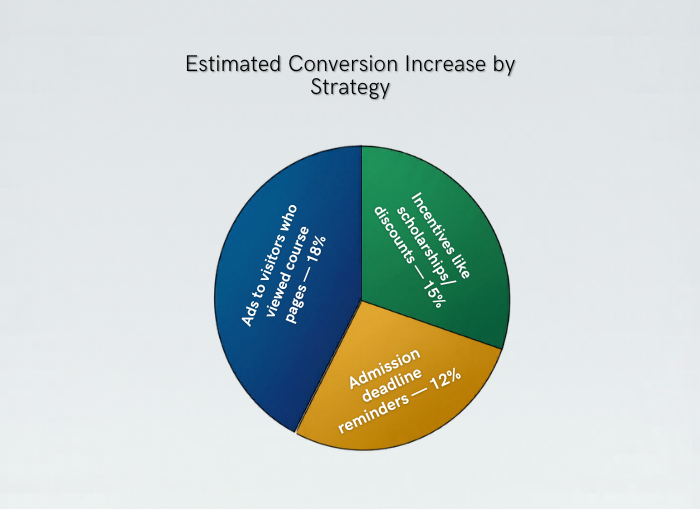
Impact:
Remarketing keeps your institute top-of-mind and increases the likelihood of conversion over time.
7. Run Campaigns Across Multiple Platforms
While search ads are essential, relying on a single platform limits your reach.
Different platforms serve different purposes in the student journey. Engagement by platform can look like this:
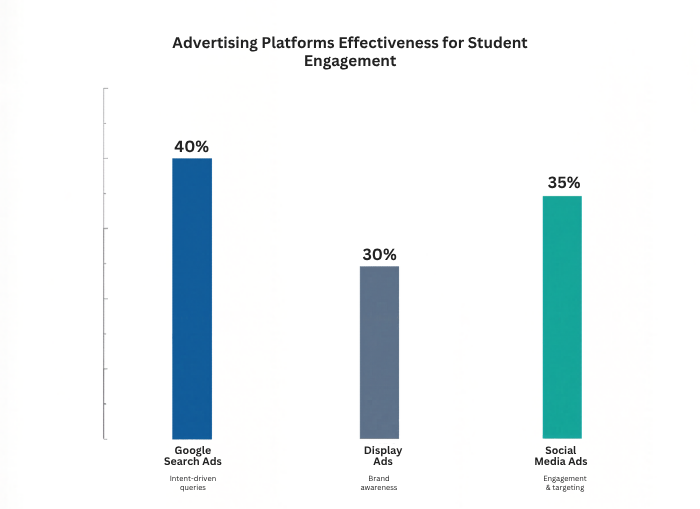
Each platform serves a different purpose in the student journey from awareness to decision-making.
8. Utilize Ad Extensions
Ad extensions enhance your ads by providing additional information and increasing visibility.
Types of extensions useful for institutes:
Extension Type | CTR Improvement* | Key Benefit |
Call Extensions | +10% | Direct inquiries |
Location Extensions | +8% | Campus visits |
Sitelink Extensions | +12% | Direct to relevant pages |
Callout Extensions | +5% | Highlight unique features |
9. Track and Measure Performance
Running PPC campaigns without tracking is like navigating without a map.
Metrics to monitor:
- Click-through rate (CTR)
- Cost per click (CPC)
- Conversion rate
- Cost per lead (CPL)
- Return on ad spend (ROAS)
Platform Comparison: Google vs Facebook vs Remarketing
Platform | CTR Range* | CPC Range* | Conversion Rate* | Best Use Case |
Google Search Ads | 3–6% | ₹80–₹250 | 5–12% | High-intent leads |
Facebook Ads | 1–3% | ₹25–₹80 | 2–6% | Awareness & targeting |
Remarketing Ads | 5–10% | ₹40–₹120 | 8–15% | Re-engaging warm leads |
Regular analysis helps identify what’s working and what needs improvement.
10. Continuously Optimize Campaigns
Creating PPC strategies is not a one-time effort; it requires ongoing optimization.
Areas to optimize:
- Keywords (add/remove based on performance)
- Ad copy (A/B testing)
- Landing pages (improve UX and content)
- Bidding strategies
Pro tip: Run A/B tests frequently to find the best-performing variations of your ads and pages.
11. Highlight Unique Selling Propositions (USPs)
Educational institutes must clearly communicate what sets them apart.
Examples of strong USPs:
- Placement records
- Industry partnerships
- Experienced faculty
- Modern infrastructure
- Global exposure
Make sure your USPs are prominently featured in ads and landing pages.
12. Align Campaigns with Admission Cycles
Timing plays a crucial role in PPC success for educational institutes.
Best practices:
- Increase budgets during admission seasons
- Run early awareness campaigns before admissions open
- Use urgency-based messaging near deadlines
This ensures maximum visibility when students are actively making decisions.
Conclusion
The truth about PPC is simple: it only performs when it’s precise. Filling search results is one thing; capturing the right student at their moment of decision is another. By mastering high-intent keywords, resonant ad copy, and strategic remarketing, you transform a ‘budget-drain’ into a seat-filling engine. In student recruitment, showing up is the start; being relevant is the win. If your institute is serious about growth, smart PPC isn’t something to consider later. It’s something to act on now.
Why is PPC advertising important for educational institutions' admissions?
PPC advertising helps educational institutions appear at the top of search results when students and parents actively search for admissions. This increases visibility and generates high-quality admission inquiries quickly.
When should an educational university start paid marketing campaigns for admissions?
Universities should ideally start their paid campaigns 3–6 months before the admission season. Early campaigns help build awareness and capture students during their research phase.
How can educational institutions improve the performance of their admission campaigns?
Educational Institutions can improve campaign performance by using targeted keywords, optimized landing pages, proper audience targeting, and continuous campaign tracking through a performance-driven digital marketing strategy.